Money, SIM Cards & Staying Connected
Thailand is easy on the wallet and easy to get online. A little planning around cash, cards, and a local SIM means you land ready to go.
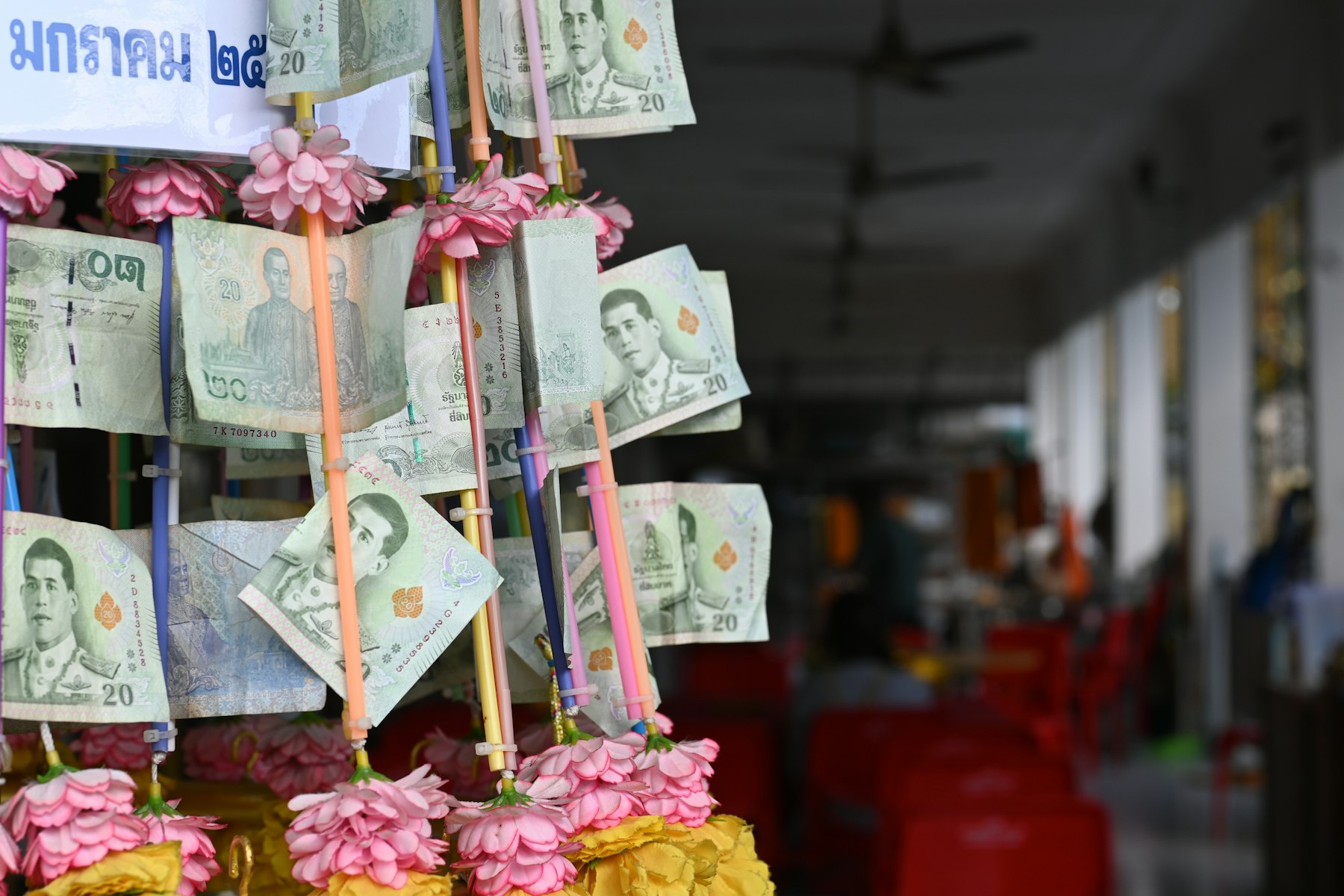

Money Basics
The Thai baht
Notes run from 20 to 1,000 baht.[1] Carry a stash of small notes and coins for street stalls, markets, and short taxi rides, where breaking a 1,000 is a pain.
Both, in their place
Cards work in malls, hotels, and bigger restaurants. Street food, markets, and small shops are cash or Thai QR (PromptPay).[2] Keep some cash on you at all times.
Everywhere, with a fee
ATMs are on every corner but charge a flat foreign-card fee, now 220 to 250 baht at most banks and up to 350 with some Mastercards.[3] AEON machines, inside Big C and Lotus’s, are the cheapest at about 150. Withdraw larger amounts less often, always choose to be billed in baht, and tell your bank you are traveling first.
Skip the arrivals-hall counters
The exchange booths in the arrivals hall give some of the worst rates in the country, sometimes 6 to 8% below the mid-market rate. Change just a little there if you need taxi money, then do the rest in the city or one floor down.
Paying by Card
Malls, hotels, chains
Visa and Mastercard are widely accepted in shopping malls, hotels, convenience stores, and mid-range and up restaurants. Contactless and Apple or Google Pay work in most of these too. Amex is more hit-or-miss.
Watch for small catches
Smaller shops and cafes sometimes set a card minimum of around 300 to 500 baht, or add a 3% surcharge to cover the card fee. If a place is card-friendly it is usually posted at the till. Below the minimum, pay cash or scan the QR.
Streets & markets
Street stalls, wet markets, songthaews, most taxis, and small family shops are cash only. Locals pay with the PromptPay QR, but that needs a Thai bank account, so as a visitor keep a daily float of small notes.
One more habit worth having: always choose to be charged in baht, not your home currency, when a card machine asks. Paying in your own currency triggers a poor built-in conversion rate.[4]
Staying Connected
The easiest option
If your phone supports eSIM, buy one before you leave, install it in a few minutes, and it activates automatically when you land, no line and no swapping cards. Most plans only start counting once you connect in Thailand.
Grab one on arrival
Prefer a physical card? Tourist SIMs from AIS, TrueMove, or dtac are sold at the airport and in any 7-Eleven, and the staff will pop it in and set it up for you. A physical SIM also comes with a Thai phone number.
Ubigi
Runs on both AIS and TrueMove, Thailand’s two biggest networks, so coverage is strong in cities and on the islands. Fixed and unlimited plans, plus monthly options for long stays.
Airalo
The best-known name, easy app, and handy if Thailand is one stop on a multi-country trip thanks to its regional Asia plans. Data-only, no Thai number.
Holafly, Saily & more
Holafly is the pick for truly unlimited data on longer stays; Saily and Nomad are solid budget picks. Whichever you choose, buy it before departure.
Coverage is excellent in Bangkok, Chiang Mai, Phuket, and the main islands, and only thins out in remote mountains or tiny islands. For a one- or two-week trip a 10 to 20 GB plan is plenty, since hotels and cafes have reliable Wi-Fi.
Flat (A and B) and round (C) pins fit the same holes, so many single-pin chargers plug straight in. Pack one universal adapter to cover everything, and a small power strip if you travel with several devices.
Tipping & Spending
Appreciated, not required
Tipping is not expected. Rounding up a taxi, leaving small change, or about 10% at a nicer restaurant with no service charge is a kind touch.
Know the going rate
Daily costs range widely from backpacker to comfortable. See our full breakdown of real Bangkok prices to set expectations before you go.
What Things Cost in Bangkok
Prices vary by location and season. These are general ranges to budget with ease.
What Your Day Costs
Drag to a daily budget and see what it buys, and roughly how to split it.
A clean air-conditioned guesthouse, a mix of street stalls and casual restaurants, Grab when the heat wins, and entry to whatever you pass.
Per person, excluding flights and long-distance transport. Bangkok and the resort islands run higher than the rest of the country. Dollar figures use a rate of about 34 baht to the US dollar, checked August 1, 2026.[5]
Rough Daily Budgets
A dorm bed or fan guesthouse, street food and market meals, and buses or the odd songthaew to get around.
A clean air-conditioned guesthouse, a mix of street stalls and casual restaurants, BTS and Grab, and entry to whatever you pass.
A well-reviewed hotel, mostly sit-down meals, taxis over public transport, and a paid tour or spa visit along the way.
Four- and five-star stays, rooftop bars, spa days, and private tours.
More First-Timer Guides
Written by Belle, a Thai American who travels to Thailand every other year and has family in Bangkok. Everything here comes from my own visits unless the text says otherwise. Prices and journey times are typical cases rather than quotes, so recheck anything time-sensitive before you pay. Rates and fees were rechecked on August 1, 2026, against the numbered sources below. Brand mentions are never paid placements, and the guide is reader-supported: some links may earn a commission, at no extra cost to you.
How we research →- 1Thai banknotes in circulation, Bank of Thailand. Supports: that notes run from 20 to 1,000 baht.
- 2PromptPay, Bank of Thailand. Supports: that Thai QR payment runs on PromptPay and is tied to a Thai bank account.
- 3ATM and debit card fee comparison, Bank of Thailand consumer portal. Supports: the flat foreign-card withdrawal fee of 220 to 250 baht at most banks, higher at some, and the lower AEON fee.
- 4Dynamic currency conversion, Visa. Supports: that choosing your home currency at a card machine applies a poorer built-in conversion rate.
- 5Daily foreign exchange rates, Bank of Thailand. Supports: the rate of about 34 baht to the US dollar used for the dollar figures on this page.